

Introduction
The essay is based on the environmentally changing aspects based on technology. One kind of revolution or another occurs with each new generation. There were revolutions in politics in certain generations and technological developments in others. The information technology revolution is the primary focus of our age. The impact of technology on people’s daily lives, economies, and traditions is growing at an unprecedented rate. The digital revolution was a huge win for the planet’s ecosystem.
When more people switch to digital gadgets, fewer trees need to be cut down to meet their information needs. Trees not only help mitigate climate change by producing oxygen but also by soaking up carbon dioxide in the air. In the following section, there will be discussions about the technological impact on the environment, the benefits, the drawbacks, balancing technology and the environment together, and future aspects. In the end, there will be a conclusion based on the essay and online assignment help.
Technological impact on the environment
The primary causes are all connected to innovations that arose in the wake of the industrial revolution, which include the use of petroleum and coal in the construction of manufacturing plants and power plants, the introduction of mass agriculture, and the widespread use of automobiles. However, water pollution occurs when natural or man-made sources of water (including lakes, rivers, seas, and groundwater) become tainted (Paramati et al., 2022).
The increasing number of greenhouse gases that are present in airborne particles trap heat in the atmosphere of the planet, leading to an overall increase in worldwide temperatures, as well as detrimental health effects for people and animals.
Another way that technology harms the environment is through depleting resources. Overuse is when something is used up quicker than it may be replaced. Whether renewable or not renewable, resources from nature refer to things that are present in the world but were not produced by people. The deterioration of the world’s natural resources is rising in tandem with the world’s population. As a consequence, the global eco-footprint is now thought to be 1.5 times greater than the planet’s capacity to sustainably supply each person with adequate resources to fulfil their dietary levels.
Any representation of nature that relies on technology, even artificially generated natural beauty, is doomed to fall short of reality in its purest form (Khan et al., 2021). Therefore, do my assignment it is said, technology cannot conserve nature and merely artificially build another aspect of exactly the same, because an intentionally induced atmosphere is considered inferior to true nature.
Scientists have suggested that technology, when used in a constructive way, do my assignment help Australia may significantly aid the environment. Because overpopulation has become one of the world’s most important challenges, the development of effective methods of preventing pregnancy is seen as a technological success.
Benefits of technology in the environment
I. Development of renewable energy
Renewable energy sources, such as the sun, the wind, and the tides, may be used to produce power in a sustainable manner. The popularity of solar power has skyrocketed in the past few years. Cleaner sources of energy like tidal and wind power are on the rise as people take their cue from them (Lahiani et al., 2021). More over 20% of the UK’s power comes from renewable sources, having surpassed coal as the nation’s second biggest producer in 2015. EU objectives suggest that this number will rise to 30% by 2020. Energy is typically vital to human growth, and although many green power projects are massive, renewable technologies are additionally suitable to isolated places and impoverished nations.
II. Saving wildlife
- To monitor endangered animals such as rhinos and elephants, scientists are developing “smart collars” equipped with GPS, kilometress, and sensors.
- Listening for signs of natural or predator-caused suffering in wild animals remotely
- Collars equipped with SIM chips for animals living in close proximity to people in order to lessen the number of confrontations between the two species
- Use of gene sequencing technology to prevent the extinction of species due to cancer and other fatal illnesses (Saunders et al., 2022).
- Drones used for conservation purposes include tracking and monitoring wild forest zones for natural calamities like forest fires.
- Animal-specific predictive analytics to catalo the world’s species and take preventative measures for them all.

Figure 1: Benefits of technology for the environment
(Source: allerin, 2018)
III. Adaptation of smarter lifestyle
The concept of the “smart car” was created along the same lines as those that help lessen the environmental impact of regular automobiles. Rechargeable batteries power electric vehicles including the “Tesla Model 3”, which distribute power to the vehicle’s components efficiently (Gioacchini et al. 2022). According to a survey, these fuel-efficient vehicles are practically three times more effective than traditionally powered vehicles, using just 17-21% of the total energy to drive the wheels.
Drawbacks
Mining minerals
Electronic gadgets and other forms of contemporary technology need a large number of renewable resources including precious metals to function. It’s a complicated picture, and components for even one phone have to be sourced from all across the globe. This may complicate a full investigation of the depletion of a resource. Deforestation, landscape deterioration, contamination of waterways, and the emission of several hazardous gases and contaminants2 are all caused by mining activities (Shahmoradi et al. 2020). There is proof that the ecosystem suffers because of our technological needs and wants. Everywhere you turn, you can see the environmental damage caused by the mining and refining of minerals including precious metals for use in electronics.
The Carbon Footprint
The origins of a technology’s basic materials are just the beginning of its environmental footprint. To transform materials into the sophisticated electrical and technical goods we rely on, companies must use enormous amounts of power. The greenhouse effect, which causes warming temperatures and pollutants in the air, is exacerbated by the global movement of these things by aircraft and vehicles. It’s also important to keep in mind that there’s a carbon penalty associated with using any electronic equipment that requires power from a non-renewable source (Usman & Radulescu, 2022). The release of greenhouse gases as well as the climate issue are both exacerbated as a result of this.
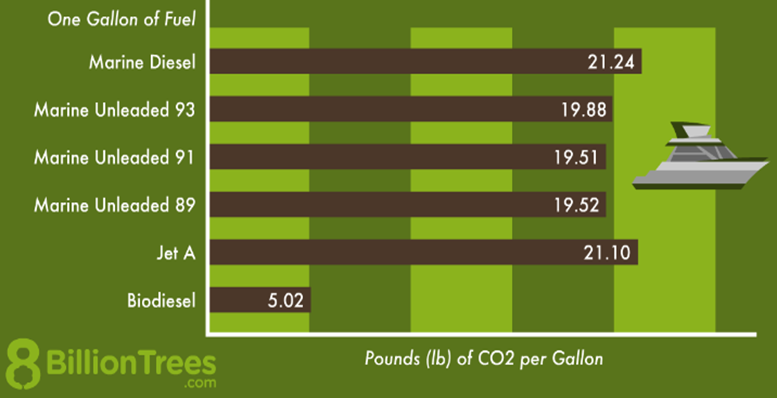
Figure: Carbon footprint from Marine Fuel
(Source: 8billiontrees, 2023)
Nitrogen oxide, particulates, carbon monoxide, as well as “non-methane volatile organic compounds” are only a few of the many toxic pollutants that boats discharge into aquatic and marine habitats. Instead, the calculations include in pollution from shipping companies.
E-waste
Only a fraction of obsolete electronic equipment is collected for recycling. However, most of them wind up in garbage dumps or landfills to be burnt. Unfortunately, these garbage dumps not only produce methane alongside other carbon emissions but also leak chemicals, including mercury, into wastewater that mixes with pollutants like pesticides (Islam et al., 2020). Toxic chemical mixtures have the potential to seep into water supplies, where they may damage aquatic life and contribute to pollution.
Balancing environment and technology
- The quantity and quality of ecosystem services that are generated are directly related to the state of such ecosystems.
- The many ecosystem services are not equally vulnerable to a decline of ecosystem health.
- The quality of ecosystems and the services they provide deteriorates linearly with time (Savva et al., 2020).
- Measurements of ecological wellness allow for precise forecasting of a decline of services provided by ecosystems vital to human civilization.
- Even in healthy or well-maintained ecosystems, there may be large variations in the provision of key services to human societies.
- Since everyone may get their hands on these materials, and no one has to pay the full price for their usage, this leads to widespread waste and environmental damage.
Future aspects
The development of new technologies has helped farmers grow more nutritious crops, which in turn has improved people’s diets and wellbeing. Now more than ever, people are eating cheaper, healthier food that doesn’t break the bank to produce. Some individuals avoid eating at hotels altogether in favour of ordering their preferred dishes online or over the phone (Kuriqi et al., 2020). They place an order when their homes or places of business get the delivered meals. Products like clothing, footwear, and bedding are mass-produced at a range of price points, so there is something for everyone.
Conclusion
It can be concluded that technology-based depictions of nature, including synthetic recreations of natural beauty, will always fall short of the genuine article. It is argued that because an artificially created atmosphere is inferior to actual nature, technological conservation of natural resources would be futile. Manufacturing the complex electronics and technological items we depend on requires a massive amount of energy. Pollution and harm to aquatic life may result from the seepage of toxic chemical combinations into water systems. Fully customized houses are the way of the future. The term “Internet of Things (IoT)” describes this concept. The houses will be organically designed to accommodate our unique routines, preferences, and requirements. Not only will it save time and effort, but it will be as well far more beneficial for the planet by cutting down on unnecessary energy use and greenhouse gas emissions.
Reference
Gioacchini, E. (2022). Produzione Additiva per Applicazioni Automobilistiche: Il Caso Studio del Telaio Ausiliario Posteriore della Tesla® Model 3 Dual Motor= Additive Manufacturing for Automotive Applications: The Case Study of Tesla®’s Model 3 Dual Motor Rear Subframe (Doctoral dissertation, Politecnico di Torino). Retrieved from: https://webthesis.biblio.polito.it/secure/25010/1/tesi.pdf [Retrieved on: 03.06.2023]
Islam, A., Ahmed, T., Awual, M. R., Rahman, A., Sultana, M., Abd Aziz, A., … & Hasan, M. (2020). Advances in sustainable approaches to recover metals from e-waste-A review. Journal of Cleaner Production, 244, 118815. Retrieved from: https://www.academia.edu/download/68185171/16_Journal_of_Cleaner_Production.pdf [Retrieved on: 03.06.2023]
Khan, S. A. R., Razzaq, A., Yu, Z., & Miller, S. (2021). Industry 4.0 and circular economy practices: A new era business strategies for environmental sustainability. Business Strategy and the Environment, 30(8), 4001-4014. Retrieved from: https://www.researchgate.net/profile/Asif-Razzaq/publication/352658917_Industry_40_and_circular_economy_practices_A_new_era_business_strategies_for_environmental_sustainability/links/60d252f0299bf19b8d9d88e3/Industry-40-and-circular-economy-practices-A-new-era-business-strategies-for-environmental-sustainability.pdf [Retrieved on: 03.06.2023]
Kuriqi, A., Pinheiro, A. N., Sordo-Ward, A., & Garrote, L. (2020). Water-energy-ecosystem nexus: Balancing competing interests at a run-of-river hydropower plant coupling a hydrologic–ecohydraulic approach. Energy Conversion and Management, 223, 113267. Retrieved from: https://www.researchgate.net/profile/Alban-Kuriqi/publication/343512337_Water-energy-ecosystem_nexus_Balancing_competing_interests_at_a_run-of-river_hydropower_plant_coupling_a_hydrologic-ecohydraulic_approach/links/5f3f997092851cd3020fabcb/Water-energy-ecosystem-nexus-Balancing-competing-interests-at-a-run-of-river-hydropower-plant-coupling-a-hydrologic-ecohydraulic-approach.pdf [Retrieved on: 03.06.2023]
Lahiani, A., Mefteh-Wali, S., Shahbaz, M., & Vo, X. V. (2021). Does financial development influence renewable energy consumption to achieve carbon neutrality in the USA?. Energy Policy, 158, 112524. Retrieved from: https://www.sciencedirect.com/science/article/am/pii/S0301421521003943 [Retrieved on: 03.06.2023]
Paramati, S. R., Shahzad, U., & Doğan, B. (2022). The role of environmental technology for energy demand and energy efficiency: Evidence from OECD countries. Renewable and Sustainable Energy Reviews, 153, 111735. Retrieved from: https://discovery.dundee.ac.uk/ws/files/67581094/Final_Version.pdf [Retrieved on: 03.06.2023]
Saunders, D., Nguyen, H., Cowen, S., Magrath, M., Marsh, K., Bell, S., & Bobruk, J. (2022). Radio-tracking wildlife with drones: a viewshed analysis quantifying survey coverage across diverse landscapes. Wildlife Research, 49(1), 1-10. Retrieved from: https://www.researchgate.net/profile/Debbie-Saunders/publication/358404185_Radio-tracking_wildlife_with_drones_a_viewshed_analysis_quantifying_survey_coverage_across_diverse_landscapes/links/6200eeb9cc7fea166855f182/Radio-tracking-wildlife-with-drones-a-viewshed-analysis-quantifying-survey-coverage-across-diverse-landscapes.pdf [Retrieved on: 03.06.2023]
Savva, A., Hallani, R., Cendra, C., Surgailis, J., Hidalgo, T. C., Wustoni, S., … & Inal, S. (2020). Balancing ionic and electronic conduction for high‐performance organic electrochemical transistors. Advanced Functional Materials, 30(11), 1907657. Retrieved from: https://onlinelibrary.wiley.com/doi/am-pdf/10.1002/adfm.201907657 [Retrieved on: 03.06.2023]
Shahmoradi, J., Talebi, E., Roghanchi, P., & Hassanalian, M. (2020). A comprehensive review of applications of drone technology in the mining industry. Drones, 4(3), 34. Retrieved from: https://www.mdpi.com/2504-446X/4/3/34/pdf [Retrieved on: 03.06.2023]
Usman, M., & Radulescu, M. (2022). Examining the role of nuclear and renewable energy in reducing carbon footprint: does the role of technological innovation really create some difference?. Science of The Total Environment, 841, 156662. Retrieved from: https://www.researchgate.net/profile/Muhammad-Usman-436/publication/361207887_Examining_the_role_of_nuclear_and_renewable_energy_in_reducing_carbon_footprint_Does_the_role_of_technological_innovation_really_create_some_difference/links/62b211f4d49f803365ae571f/Examining-the-role-of-nuclear-and-renewable-energy-in-reducing-carbon-footprint-Does-the-role-of-technological-innovation-really-create-some-difference.pdf [Retrieved on: 03.06.2023]