

Introduction
Future action and goals will be outlined in an environmentally friendly production and consumption system for the United Kingdom. The ‘Changing Patterns’ paradigm unites the financial and environmental arguments for sustainable consumption and manufacturing that need to be addressed immediately. The new “UK Sustainable Development Strategy” (UK SDS) includes “Sustainable Consumption and Production” as one of its four core themes. All areas of the 3Rs, including goods, manufacturing, eco-design, use, innovation, business collaborations, and trash, will be addressed as part of our plan to advance sustainable usage and manufacturing. In the following sections, Online Assignment help Birmingham, there will be a discussion based on the importance of waste generation reduction, advantages, and disadvantages, government administration policies, community involvement, and future aspects with recommendations. In the end, there will be a conclusion based on this.
Importance of waste generation reduction
Effects on Society and the Economy
Recycling and trash reduction are crucial for several reasons. Although the environmental benefits of trash reduction get the most attention, there are other benefits as well, including financial savings and social benefits through the creation of new recycling-related enterprises (Yu et al. 2021). Aware consumers may save costs by essay typer and buying just what the UK needs and finding creative ways to reuse otherwise discarded materials.
Reducing Waste Disposal Waste
Less trash means fewer landfills, which consume up precious real estate and contribute to environmental degradation by releasing toxic chemicals into the air and water.
Efforts Made to Reduce Waste
People are doing their part to save resources by the help of nursing dissertation help and cutting down on trash. Cans, bags of plastic, and paper wrapping are all examples of modern products made from previously utilized resources like aluminium, petroleum, and wood. Researchers have estimated the amount of “biodegradable municipal waste (BMW)” sent to landfills in the United Kingdom by taking a countrywide approach, as required by law (Stevens et al. 2022). Methane is a strong greenhouse gas that may be produced by the decomposition of municipal trash in a landfill, and this percentage is referred to as BMW.
Reduced Energy Use
When compared to producing new materials, recycling uses far less energy. Energy efficiency is greatly improved by reducing the need for additional resources in the production of consumer products, which is an energy-intensive operation. For each year 2019, 2020, and 2021, the expected total quantity of packaging materials put on the UK market is subtracted from the total quantity of packaging recorded as being recovered under the legislation in that year, yielding the recovery/recycling rate for that year in the United Kingdom.
Secure future
Polluting emissions of greenhouse gases are released throughout the mining, refinery, and manufacturing processes. People can leave their children and grandkids a better world by recycling, reusing, and reducing trash (Stubbings et al. 2021). Since the Earth’s natural resources and waste disposal capabilities are finite, it’s crucial that we all do what people can now to ensure a brighter tomorrow.
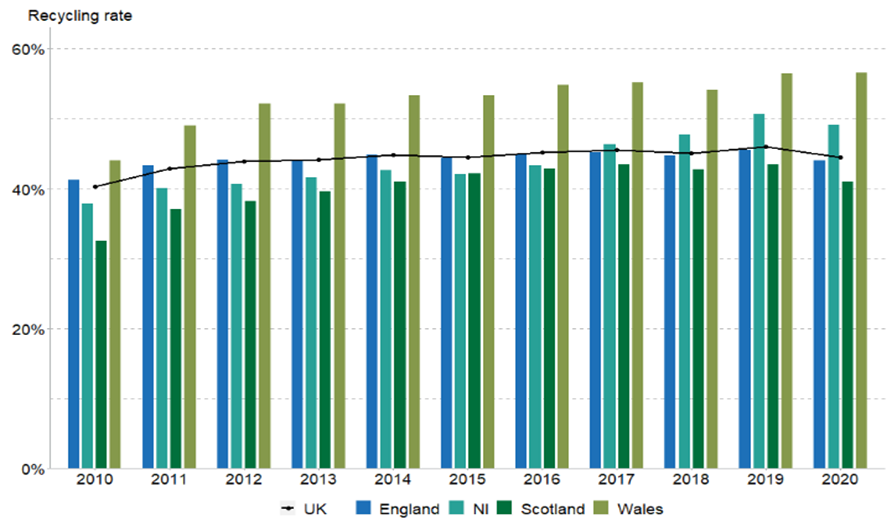
Figure 1: Recycling waste rate in the UK
(Source: gov.uk, 2020)
The total amount of WfH produced in the UK in 2020 was 27.0 million tonnes, up 2.1% from 2019. In 2020, England will produce 22.6 million metric tons of WfH, or 84% of the total amount produced for the UK. In 2020, the WfH recycling rate in the UK dropped to 44.4% (which includes IBA metal) from 46.0% in 2019.
In 2020, the reuse and recycling rate of domestic garbage fell in the United Kingdom, with the exception of Wales. Compared to Northern Ireland (49.1%), Scotland (41.0%), and Wales (56.5%), England’s recycling rate was much lower at 44.0%.
Repurposing and reusing
Benefits of repurposes and reuses
- Decreases the release of climate-altering greenhouse gases.
- Using fewer new resources helps keep the environment clean.
- Reduces use of resources.
- Decreases the release of gases that play a role in global warming.
- Aids in long-term environmental preservation (Gursel et al. 2022).
- Consequently, fewer recyclables and trash are generated, reducing the strain on recycling programs and waste disposal facilities.
- enables consumers to get the most out of a product.
- Reduces costs.
Initiation of promoting various waste reduction management
The United Kingdom needs to implement strict laws and regulations for waste management, with an emphasis on waste prevention, reuse, and recycling. This includes lofty goals for decreasing trash sent to landfills and boosting recycling participation. In addition, “Extended Producer Responsibility (EPR)” programs may make producers responsible for their goods throughout their entire lifespan, which in turn motivates manufacturers to create recyclable and reusable items from the start (Dawson et al. 2021). A move toward more sustainable options may be accelerated by stricter rules on disposable plastics and packaging.
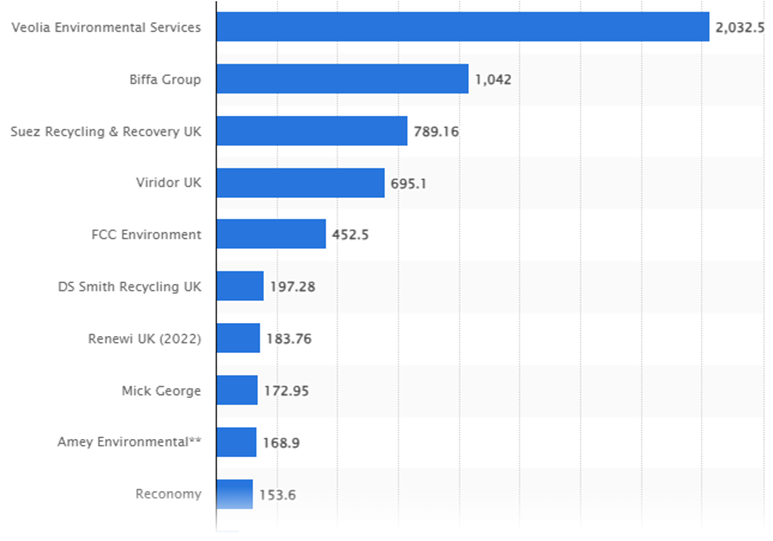
Figure 2: Waste management service companies in the UK
(Source: statista, 2022)
Raising public knowledge of waste reduction and oversight is essential to encourage behavioural change, hence efforts should be made to increase public understanding as well as instruction. Individuals may be encouraged to make choices that are more environmentally friendly via the implementation of educational programs and projects that promote trash reduction techniques, recycling procedures, and correct disposal methods (Ahlers et al. 2021). Spreading the word and getting people involved in initiatives to reduce waste may be aided by using educational institutions, community groups, and the media. Successful waste management requires the formation of collaborations between the public and private sectors to fund educational initiatives and provide necessary resources.
Advantages and disadvantages
Advantages
- Recycling commercial trash reduces the amount of trash sent to landfills and thereby reduces environmental damage.
- Reducing waste and increasing recycling may boost a company’s image, bringing in fresh clients and encouraging existing ones to stick around.
- Saving money on landfills tax is a major benefit of minimizing trash disposal expenses (Tongue et al. 2021). Managing and disposing of garbage is an expensive endeavour.
Disadvantages
- While it’s true that recycling office trash might have environmental benefits, minimizing trash production or finding other uses for it would be better.
- People may be possible to negotiate more frequent pickups with the waste disposal contractor if the company has enough room for recycling (collecting and sorting waste items for recycling takes space, which can be difficult to locate on the company’s premises).
Community involvement
Educational Awareness
Community-level educational initiatives and seminars may promote the 3Rs while offering waste-reduction recommendations. Reduce single-use plastics, and organic matter, and separate recyclables in seminars (Debrah et al. 2021). People in the community may make informed decisions and actively reduce waste by being educated.
Community Recycling
Community recycling initiatives promote recycling. Recycling is simpler with easy recycling collection stations in communities, schools, and other centres for the community. Instructional materials, signs, and frequent recycling updates may promote beneficial practices.
Community composting
Community composting helps remove organic matter from landfill and generate compost that is rich in nutrients for community greenhouses and regional agriculture. Neighbourhood compost heaps or facilities allow people to donate scraps of food plus yard debris. This saves waste and fosters communal collaboration.
Local Business Collaboration
Local companies and groups may reduce trash significantly. Partnering with merchants, restaurants, plus supermarkets to decrease packaging waste, encourage reusable alternates, and encourage recycling may have a community-wide impact (Karki et al. 2021). Encouraging firms to begin sustainable practices and rewarding them may boost their engagement.
Future aspects and innovations
The UK can improve the 3Rs with new technologies. This involves developing recyclable chemicals and bio-based products to effectively recover as well as reuse valuable resources from the trash. Online communities and smart technologies may let people share and trade reusable objects, encouraging reuse and lowering the consumption of new products.
The UK is moving toward a circular economy based on the 3Rs to maximize resource utilization. 3R will guide product design. Extended manufacturer accountability programs may encourage a system with a closed loop and minimize waste by making manufacturers more accountable for item end-of-life.
Responsible consumption will shape the 3Rs’ future. The UK may encourage conscientious consumers to make decisions such as choosing minimally packaged items, reusable alternates, and contributing to the economy (Huang et al., 2021). Consumers may make better choices by learning about consumption’s environmental effects as well as sustainable alternatives.
Implementing the 3Rs will need strong administration, and corporate, community, and NGO collaborations. Collaboration may foster systemic change, information exchange, and recycling and waste management infrastructures. Multi-stakeholder cooperation may boost 3Rs creativity, investigation, and finance.
Conclusion
It can be concluded that the United Kingdom should encourage the use of circular economy ideas in order to reduce waste and optimize resource use. The linear “take-make-dispose” approach is replaced with a circular system in which goods are created with reuse, repair, and recycling in mind. A more environmentally friendly and circular economy may be fostered via the promotion of product longevity, repair services, and incentives for the use of recycled materials in production. Invention and the growth of practices related to the circular economy may be bolstered through partnerships between enterprises, academic institutions, plus local communities. The future of the 3Rs will depend on the choices consumers make now. The United Kingdom has the potential to influence environmentally conscious shoppers to make choices that benefit the economy, such as purchasing products with minimum packaging or opting for reusable alternatives. Learning about the environmental impact of consumption and sustainable alternatives may help consumers make more informed decisions.
Reference
Ahlers, J., Hemkhaus, M., Hibler, S., & Hannak, J. (2021). Analysis of Extended Producer Responsibility Schemes. Retrieved from: https://erp-recycling.org/wp-content/uploads/sites/39/2021/07/adelphi_study_Analysis_of_EPR_Schemes_July_2021.pdf [Retrieved on: 04.06.2023]
Dawson, L., Ahuja, J., & Lee, R. (2021). Steering extended producer responsibility for electric vehicle batteries. Environmental Law Review, 23(2), 128-143. Retrieved from: https://journals.sagepub.com/doi/pdf/10.1177/14614529211006069 [Retrieved on: 04.06.2023]
Debrah, J. K., Vidal, D. G., & Dinis, M. A. P. (2021). Raising awareness on solid waste management through formal education for sustainability: A developing countries evidence review. Recycling, 6(1), 6. Retrieved from: https://www.mdpi.com/2313-4321/6/1/6/pdf [Retrieved on: 04.06.2023]
Gursel, A., Shehabi, A., & Horvath, A. (2022). Where Do Environmental Benefits from Repurposing Office Buildings into Apartments Come from?. Retrieved from: https://www.researchsquare.com/article/rs-1549306/latest.pdf [Retrieved on: 04.06.2023]
Huang, I. Y., Manning, L., James, K. L., Grigoriadis, V., Millington, A., Wood, V., & Ward, S. (2021). Food waste management: A review of retailers’ business practices and their implications for sustainable value. Journal of Cleaner Production, 285, 125484. Retrieved from: https://hau.repository.guildhe.ac.uk/id/eprint/17611/1/Iona%20Huang%20Food%20waste%20management%20upload.pdf [Retrieved on: 04.06.2023]
Karki, S. T., Bennett, A. C., & Mishra, J. L. (2021). Reducing food waste and food insecurity in the UK: The architecture of surplus food distribution supply chain in addressing the sustainable development goals (Goal 2 and Goal 12.3) at a city level. Industrial Marketing Management, 93, 563-577. Retrieved from: https://eprints.whiterose.ac.uk/170771/1/Surplus%20food%20distribution%20supply%20chain%20%281%29.pdf [Retrieved on: 04.06.2023]
Stevens, J., Espinosa, R., & Prasad, A. (2022). Implementing Scotland’s landfill ban. Ricardo Energy & Environment. Retrieved from: https://era.ed.ac.uk/bitstream/handle/1842/38513/cxc-implementing-scotlands-landfill-ban-final-report-jan-2022.pdf?sequence=3&isAllowed=y [Retrieved on: 04.06.2023]
Stubbings, W. A., Abdallah, M. E., Misiuta, K., Onwuamaegbu, U., Holland, J., Smith, L., … & Harrad, S. (2021). Assessment of brominated flame retardants in a small mixed waste electronic and electrical equipment (WEEE) plastic recycling stream in the UK. Science of the Total Environment, 780, 146543. Retrieved from: https://research.birmingham.ac.uk/files/117412785/StubbingsWA2021Assessment.pdf [Retrieved on: 04.06.2023]
Tongue, A. D., Fernie, K. J., Harrad, S., Drage, D. S., McGill, R. A., & Reynolds, S. J. (2021). Interspecies comparisons of brominated flame retardants in relation to foraging ecology and behaviour of gulls frequenting a UK landfill. Science of the Total Environment, 764, 142890. Retrieved from: https://eprints.gla.ac.uk/224017/2/224017.pdf [Retrieved on: 04.06.2023]
Yu, A. T., Wong, I., Wu, Z., & Poon, C. S. (2021). Strategies for effective waste reduction and management of building construction projects in highly urbanized cities—A case study of Hong Kong. Buildings, 11(5), 214. Retrieved from: https://www.mdpi.com/2075-5309/11/5/214/pdf[Retrieved on: 04.06.2023]