

Introduction
The ability to take good notes while reading is essential for learning and remembering the material. Mastering the technique of note-taking may greatly improve one’s comprehension, whether one is studying, performing research, or just trying to get a better handle on the material presented in a piece of writing. Learn how to take business ethics assignment help Leicester and better notes when reading with this complete list of 10 suggestions. Using these methods, students may save time, write notes that are easy to understand and organize, and produce a useful tool for study and memory jogging. This article delves into these fundamental note-taking strategies, equipping readers with the tools they need to get the most out of their reading time.
Discussion
10 Tips
Noting down crucial information
Students shouldn’t feel like student have to take dictation during a lecture. Listen carefully to the lectures so that students don’t miss any of the major ideas, arguments, or topics (ZALUKHU, 2022). The fact that LSE lessons are recorded makes it easy to review material later on if students feel like student may have missed anything.
Pay Attention
It’s simple to lose focus during class and forget crucial information. Get some shut-eye before class so students can pay attention and not nod off. Some students drink coffee or chew gum before classes to stay awake (Mertens & Adams, 2021). Pay close attention when the instructor uses an example to illustrate a subject. An illustration may be a powerful tool for retaining information for later use.
Italicise, Boldface, and Underline
Certain words and phrases are regularly emphasized or drawn attention to by lecturers and help you in essay writing service Sheffield. Please emphasize these terms by underlining or highlighting them on the notebook. Students might also benefit from incorporating these phrases into the group conversations so that students can get more comfortable with them.
Make use of abbreviations
In order to keep up, it may be necessary to write down certain terms in abbreviated but still intelligible versions (Gustanti & Ayu, 2021). Spend some time coming up with a system of abbreviations that works for you. The use of abbreviations, such as “2” for “to,” “too,” and “two,” “da” for “the,” “w/” for “with,” “btw” for “between,” etc.
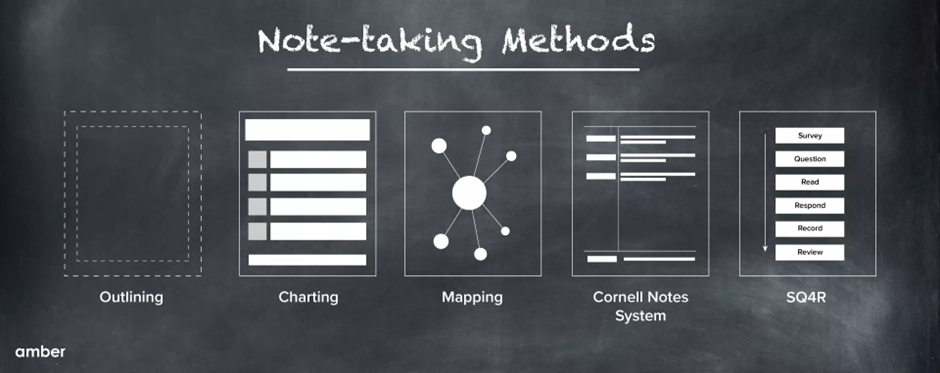
Figure 1: Note-taking methods
(Source: amberstudent, 2023)
Clear the mind
Students should probably disable the WiFi during class so students don’t get any WhatsApp or Facebook notifications that may be distracting (Wienecke et al., 2023). Please turn off the volume on the phone and refrain from using earbuds or headphones.
Feel at Home
Be on time for classes and choose a seat towards the front for maximum comfort. If a student’s usual seat in class is occupied, they may get disinterested in attending. Find a seat where students can relax and concentrate on the lesson. The middle or back row is ideal for me. Backseat driving is a major distraction for students (Bono et al., 2022). They reminded me of the rowdy kids in the back of the classroom who would laugh and plot pranks to play on the professors and other pupils.
Don’t be afraid to seek clarification
Do not just record information that students do not fully grasp. When students don’t understand anything, dissertation writing service Croydon and don’t be afraid to ask for an explanation. Students may always find time in the lecturer’s schedule during a break, after class, or during Office Hours to ask for further information if student need it.
Discuss and Contrast
The old proverb states that two minds are more effective than one. Time spent comparing and updating one another’s notes (class notes) is time well spent. Perhaps they were able to pick up on details that students missed.
The Notebook vs. the Computer
There’s been a lot of back and forth over which one of these two is better for taking notes in class. It has been argued that notepads are antiquated and that computers are disruptive (Dickfos, 2019). Which one works best for students is up for debate. But there are still classes where I can’t live without a notebook. The key is to find what helps you.
Share the thoughts
The lecturer may also ask questions. Professors may sometimes invite students to respond to questions or comments. Do not feel excluded. Share the thoughts on the topic and how the experiences have informed your perspective on it. The lectures and workshops also provide extra time for introspection.
Recommendations
- The best way to take notes depends on the subject matter and the intended use. The Cornell technique or mind map, for example, may be useful for classes and scholarly reading, whereas outlines and notes are better suited to light reading. Make sure the strategy is well-suited to the subject matter and the objectives.
- Avoid making notes and then never looking at them again by reviewing and revising them on a regular basis. Reviewing and updating the notes on a regular basis can help students retain more of the material and improve their knowledge (Chimah et al., 2021). This method ensures that the notes will continue to be useful over time by allowing students to see any blanks or regions that require more explanation.
Conclusion
During a lecture, students shouldn’t feel pressured to take dictation. Students should take notes while listening to lectures so that they are not missing any of the lecture’s essential ideas, arguments, or themes. It may be important to record certain words in shortened but understandable forms if you want to stay up. The format of a good note might vary from one individual to the next, or even from one piece of writing to the next. The concept that copying huge chunks of text is unnecessary is essential to effective note taking. Writing things down is not an effective way to acquire and retain knowledge since it does not require much mental effort.
Reference
Bono, G., Duffy, T., & Moreno, S. (2022). Gratitude in school: Benefits to students and schools. Handbook of positive psychology in schools, 118-134. Retrieved from: https://sites.hofstra.edu/jeffrey-froh/wp-content/uploads/sites/86/2019/11/HPPIS_Final-Chapter_2009.pdf [Retrieved on: 03.10.2023]
Chimah, J. N., Otuonye-Chris, N., & Ezenwuzor, L. N. (2021). Sustainable Lifelong Reading in the Digital Age: Benefits, Challenges and Solutions. Retrieved from: http://jatlim.org/volumes/Volume%207%20No%202/Jonathan.pdf [Retrieved on: 03.10.2023]
Dickfos, J. (2019). Academic Professional Development: Benefits of a Pracademic Experience. International Journal of Work-Integrated Learning, 20(3), 243-255. Retrieved from: https://files.eric.ed.gov/fulltext/EJ1232894.pdf [Retrieved on: 03.10.2023]
Gustanti, Y., & Ayu, M. (2021). THE CORRELATION BETWEEN COGNITIVE READING STRATEGIES AND STUDENTS’ENGLISH PROFICIENCY TEST SCORE. Journal of English Language Teaching and Learning, 2(2), 95-100. Retrieved from: http://jim.teknokrat.ac.id/index.php/english-language-teaching/article/download/1452/446 [Retrieved on: 03.10.2023]
Mertens, G. E., & Adams, B. (2021). Where Does Information Come From?: Visibility in Author’s Notes for Emergent Information Literacy. The Reading Teacher, 75(2), 227-231. Retrieved from: https://www.researchgate.net/profile/Brittany-Adams-2/publication/352842387_Where_Does_Information_Come_From_Visibility_in_Author%27s_Notes_for_Emergent_Information_Literacy/links/616074a3ae47db4e57a93807/Where-Does-Information-Come-From-Visibility-in-Authors-Notes-for-Emergent-Information-Literacy.pdf [Retrieved on: 03.10.2023]
Wienecke, L. M., Leiss, D., & Ehmke, T. (2023). Taking notes as a strategy for solving reality-based tasks in mathematics. International Electronic Journal of Mathematics Education, 18(3), em0744. Retrieved from: https://www.iejme.com/download/taking-notes-as-a-strategy-for-solving-reality-based-tasks-in-mathematics-13312.pdf [Retrieved on: 03.10.2023]
ZALUKHU, A. (2022). The Effectiveness of Using Personal Vocabulary Notes (PVN) To Improve Students Reading Comprehension of Eleven Grade in SMA Negeri 13 Medan. Retrieved from: https://repository.uhn.ac.id/bitstream/handle/123456789/7380/ATALISI%20ZALUKHU.pdf?sequence=1&isAllowed=y [Retrieved on: 03.10.2023]